
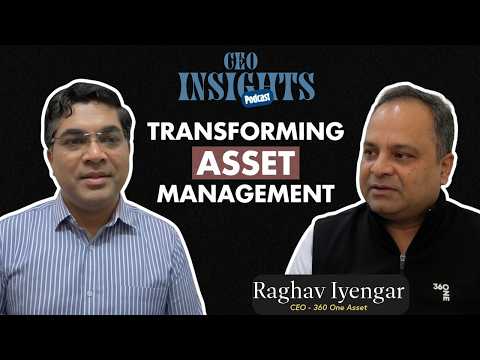
Radhakrishnan Chonat: Good day, ladies and gentlemen. Welcome to CEO Insights by AlphaStreet, where we speak with leaders shaping the future of Indian business and finance. Today, I’m absolutely delighted to host Raghav Iyengar, the CEO of 360 One Asset, one of India’s leading asset management and alternative platforms. Raghav brings over three decades of experience across the financial services industry, with leadership roles at Axis Asset Management, ICICI Prudential, and Tata Asset Management. At 360 One Asset, he is leading the growth agenda across public markets, private equity, private credit, real estate, PMS, and institutional solutions. Raghav, thank you so much for joining us.
Raghav Iyengar: Thank you so much, RC, for having me. It’s an absolute honor. We have many investment avenues here, and it’s a privilege to work with some of the best minds to bring these to our investors.
Structural Changes: From Trading to Trust
Radhakrishnan Chonat: You’ve spent over three decades across multiple market cycles. When you look at the Indian asset management industry today versus the late 90s, what is the single biggest structural change you see?
Raghav Iyengar: The biggest change is a five-letter word: Trust. We are far more accepted than we were 30 years ago. This is thanks to a far-sighted regulator that structured regulations to ensure investor interests remain front and center while giving asset managers the freedom to operate.
In the late 90s, people used to trade in mutual funds like they trade in stocks today, pulling money out if the NAV went up a rupee or two. Today, that has shifted from a trading mindset to an investing mindset. I’ve literally seen a 100x journey. In 1998, the industry was around 80,000 – 90,000 crores; today, it’s at 81 lakh crores. Despite this, I believe the industry is still in its infancy with a long way to go.
Lessons from Market Crises
Radhakrishnan Chonat: What leadership lessons did each phase of your career teach you? Was there a specific crisis that changed how you think about risk?
Raghav Iyengar: Financial markets are a “moving curriculum.” Every crisis teaches you something different. 1992 was about the capital market explosion; 1995 taught us the danger of investing blindly on narratives without doing homework.
One key lesson is that trust and transactions don’t go together. Trust is built and held over long periods. Another lesson is that investors are far smarter than we think, especially now that information is democratic. Finally, in a crisis, you must communicate much more. When markets give 20% returns, silence is fine. But during “zero return phases,” like what many new post-COVID investors are seeing now, you must reaffirm that equity markets go through cycles.
The Power of Optimism
Raghav Iyengar: To invest in equities, you have to be a perpetual optimist. My blood group is “B Positive,” and that reflects my life. I don’t worry about markets going down; I look at the long-term part. If you walk around the country today, you see progress – cleaner train stations, the new coastal road in Bombay, and shorter travel times to Pune. As humans, we are programmed to see the negative, but the ground reality in India is quite positive.
Institutional vs. Retail Behavior
Radhakrishnan Chonat: How do institutions think differently compared to retail investors during volatile markets?
Raghav Iyengar: There are three big differences:
- Idle Cash: Institutions are very disciplined. A corporate treasurer gets irritated if even one crore is sitting idle in a current account instead of a liquid fund. Retail investors are often casual about idle finances.
- Profit and Loss: Retail investors are quick to take profits but very slow to take losses. Corporates are “merciless” on both sides; they have the discipline to correct a wrong decision.
- Review Process: Corporates have stringent, formal reviews. Retail investors either check their apps every hour (which is unnecessary) or don’t check at all. I tell retail investors they need a financial partner to act as a mirror and help them be more systematic.
The 360 One Strategy and “Secret Sauce”
Radhakrishnan Chonat: What differentiates 360 One from traditional AMCs?
Raghav Iyengar: We cater to very astute, affluent investors. We have five different investment teams, each led by veterans with 25+ years of experience. We use codified approaches, like the “5C approach” in credit and the “SCDB” (Secular Defensive Value Trap) approach in equities.
Our “secret sauce” isn’t just AI, it’s culture. Long before it was fashionable, we used AI as an enabler. We use a Wiki-based platform to document every conversation, data point, and forensic check. Ten years later, I can press a button and see exactly why we bought or didn’t buy a stock. But AI is just a tool; the magic happens in our Wednesday meetings where 20 minds exchange ideas regardless of rank. You can’t disrupt that culture with AI.
Private Credit: Opportunities and Risks
Radhakrishnan Chonat: Private credit is a hot theme. What is driving this, and what are the risks?
Raghav Iyengar: In India, it’s easy to lend money at 15–18%, but it’s difficult to recover it. That is the risk. Unlike the US, the Indian regulator is very traditional, we don’t use leverage in these funds, and we don’t have “temporary gates” for liquidity. 360 One is one of the largest private credit managers; we deployed 6,000 crores last year and have a track record of zero defaults or delays. You should only give money to people with a proven track record because if two out of ten investments go wrong, you lose your entire alpha.
The Next Decade of Wealth Creation
Radhakrishnan Chonat: Where will India’s next decade of wealth creation come from?
Raghav Iyengar: 70–80% will come from manufacturing, financialization, the digital economy, and infrastructure. The other 20% will come from things we can’t even conceive of yet. We are seeing a “reverse brain drain” in space and defense. Indian enterprises are now supplying NASA.
I’m particularly excited about Tier 2 and Tier 3 towns. More than 50% of MSME registrations are coming from there. Our economic foundations are far stronger today than in 2013. We are a democracy where we can change leaders every five years, and while that might make the pace of growth seem slower to some, it ensures we take everyone along.
Final Advice for the Next Generation
Radhakrishnan Chonat: What is your advice for young professionals?
Raghav Iyengar: I usually avoid giving advice, but I’ll say three things:
- Be inherently curious.
- Learn to accept mistakes.
- Work well within teams.
The current generation is far sharper and more confident than we were. By 2030, one in six workers in the world will be Indian. That demographic story gives us a 25–30 year window of massive opportunity. I am an eternal optimist about where this country is headed.