

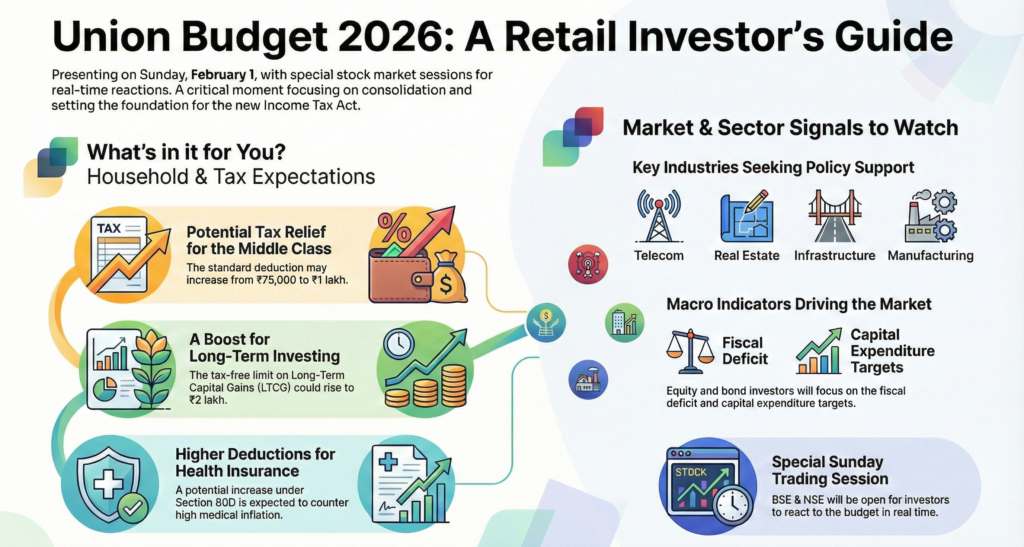
Finance Minister Nirmala Sitharaman is set to present India’s Union Budget for 2026–27 on Sunday, February 1 — a rare weekend presentation and the first since 2017. Reflecting the significance of the event, both Bombay Stock Exchange and National Stock Exchange will hold special trading sessions, enabling investors to react to policy announcements in real time.
This will be Sitharaman’s ninth consecutive Budget, equaling a national record and underscoring her central role in shaping India’s post-pandemic economic direction, aligned with the government’s long-term “Viksit Bharat 2047” vision.
A Budget at a Policy Inflection Point
The Union Budget 2026 arrives at a critical juncture. It will serve as the first policy foundation for the revised tax regime under the Income Tax Act, 2025, which comes into effect on April 1, 2026. Unlike last year’s structural overhaul, analysts expect a more pragmatic approach this time — prioritizing consolidation, administrative efficiency, and smoother compliance over sweeping reform.
For retail investors, this signals a possible emphasis on stability rather than disruption, with incremental changes aimed at improving predictability for households and businesses alike.
Tax Expectations and Household Focus
Middle-class taxpayers will be closely tracking announcements for relief amid persistent inflationary pressures. Market expectations include a potential increase in the standard deduction from ₹75,000 to ₹1 lakh, along with a higher Long-Term Capital Gains (LTCG) tax-free threshold, possibly rising from ₹1.25 lakh to ₹2 lakh to promote long-term investing.
Healthcare is another area in focus. With medical inflation estimated at 11–14%, industry voices are advocating for enhanced health insurance deductions under Section 80D, particularly for senior citizens.
Sectoral Signals to Track
Several sectors have flagged policy priorities ahead of the Budget. The telecom industry has sought a reduction in license fees to ease financial stress, while the real estate sector is pushing for a revision in affordable housing thresholds in metropolitan areas and higher home loan interest deductions. Infrastructure, manufacturing, banking, and digital services are also expected to remain central to the government’s growth narrative.
Markets, Math, and the Road Ahead
From a market perspective, fiscal deficit targets, capital expenditure allocation, and borrowing plans will be closely scrutinized by equity and bond investors. Currency markets, meanwhile, tend to respond to the broader fiscal stance rather than individual announcements.
As the traditional Halwa Ceremony ushers in the Budget “lock-in” period at North Block, attention now turns to the Economic Survey, scheduled for January 31. Its growth projections and economic assessment will set the strategic context for Sunday’s presentation — a policy moment that retail investors will watch closely, not just for immediate market cues, but for signals on the year ahead.