
India’s federal budget for 2026–27 set out a range of measures aimed at social inclusion and welfare, including targeted programmes for Divyangjan, expansion of mental health and trauma care, support for rural women-led enterprises, and focused development initiatives in Purvodaya and the North-Eastern region, Finance Minister Nirmala Sitharaman said in her budget speech to parliament on Saturday.
Presenting the proposals, Finance Minister Sitharaman said these initiatives flow from the government’s third “kartavya” — ensuring that every family, community, region and sector has access to resources, amenities and opportunities for meaningful participation in economic growth.
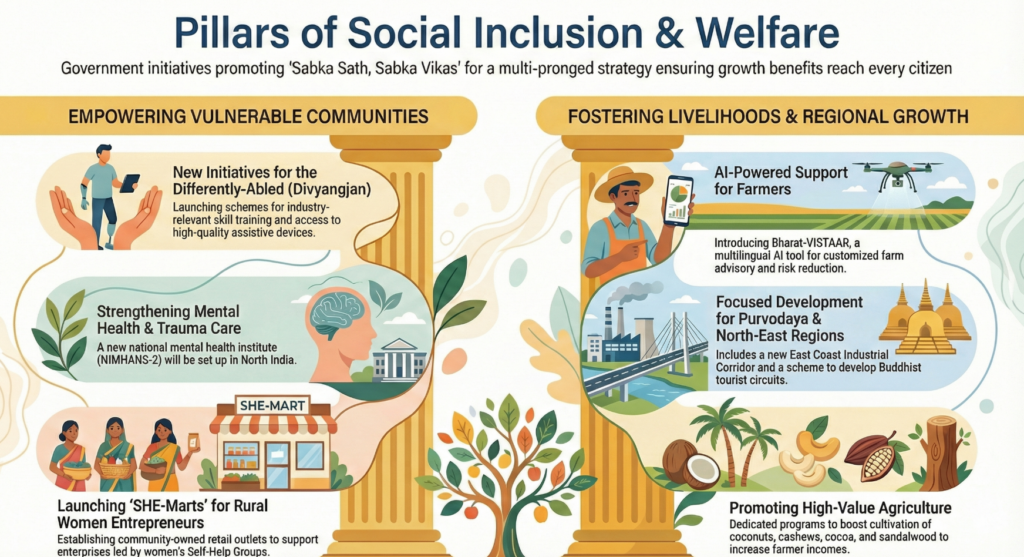
Under the programme for Divyangjan, the budget proposed two schemes. The Divyangjan Kaushal Yojana will provide industry-relevant, customised training in sectors such as IT, AVGC, hospitality and food and beverages to enable dignified livelihood opportunities. The finance minister said these sectors offer task-oriented and process-driven roles suitable for Divyangjan.
For assistive devices, Finance Minister Sitharaman proposed the Divyang Sahara Yojana, under which the Artificial Limbs Manufacturing Corporation of India (ALIMCO) will be supported to scale up production, invest in research and development, and integrate artificial intelligence. The scheme will also strengthen PM Divyasha Kendras and establish Assistive Technology Marts as modern retail-style centres where Divyangjan and senior citizens can see, try and purchase assistive products.
On mental health and trauma care, the budget proposed establishing NIMHANS-2 to address the absence of national mental health institutes in north India. Existing National Mental Health Institutes in Ranchi and Tezpur will be upgraded as regional apex institutions.
To improve emergency healthcare, the finance minister said capacities in district hospitals would be increased by 50% through the establishment of additional Emergency and Trauma Care Centres.
For rural women-led enterprises, the budget proposed setting up SHE-Marts (Self-Help Entrepreneur Marts) as community-owned retail outlets within cluster-level federations, using enhanced and innovative financing instruments. The initiative builds on the Lakhpati Didi Programme, according to the speech.
In the Purvodaya States (Bihar, Jharkhand, Odisha, West Bengal and Andhra Pradesh), the budget proposed an integrated East Coast Industrial Corridor with a well-connected node at Durgapur, the creation of five tourism destinations, and the provision of 4,000 e-buses.
In the North-Eastern Region, Finance Minister Sitharaman proposed a Scheme for Development of Buddhist Circuits in Arunachal Pradesh, Sikkim, Assam, Manipur, Mizoram and Tripura. The scheme will cover preservation of temples and monasteries, pilgrimage interpretation centres, connectivity and pilgrim amenities.
On fiscal devolution relevant to welfare spending, the finance minister said the government accepted the 16th Finance Commission’s recommendation to retain the vertical share of devolution at 41%, and provided ₹1.4 lakh crore to states for 2026–27 as Finance Commission Grants, including Rural and Urban Local Body and Disaster Management Grants.
No sector-specific taxation changes, borrowing plans or separate capital expenditure figures were announced exclusively for social inclusion and welfare beyond the measures listed in the speech.