
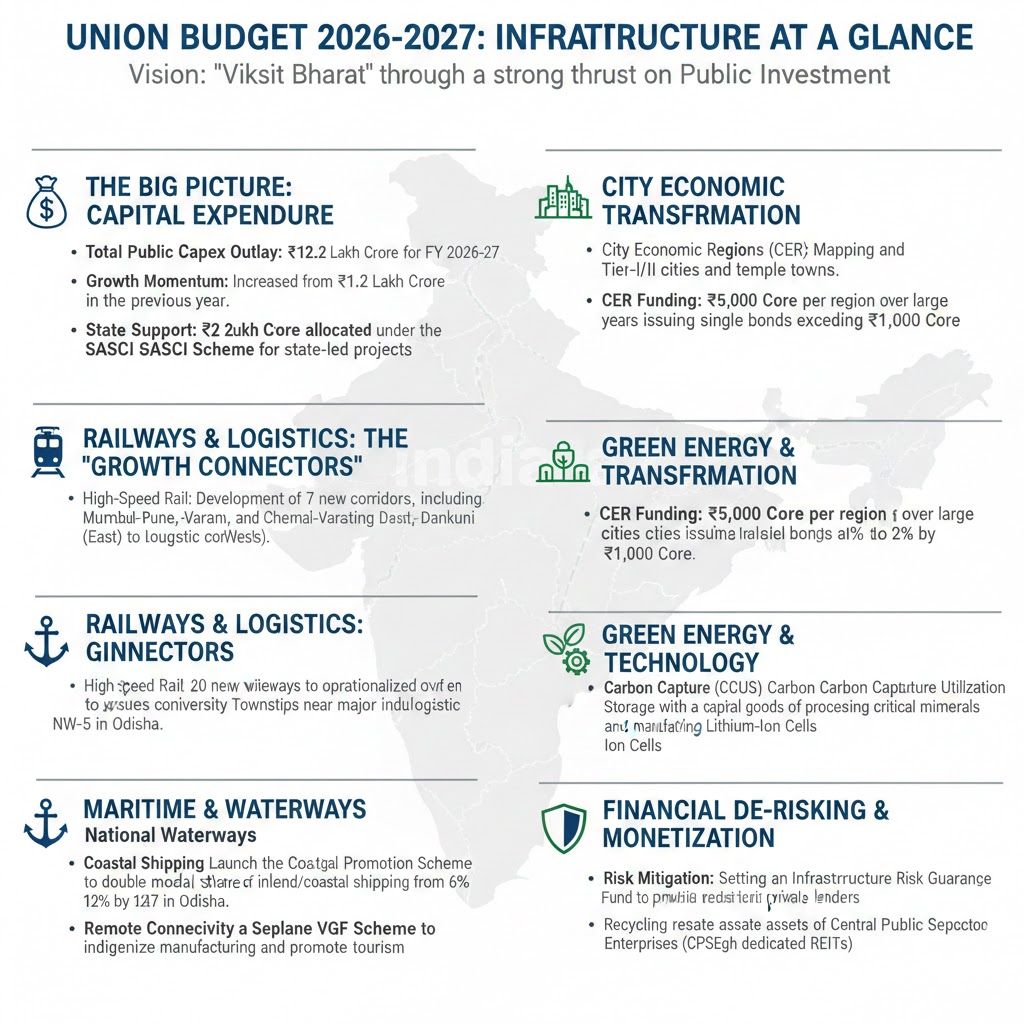
India’s Finance Minister Nirmala Sitharaman on Feb. 1 unveiled the Union Budget for 2026-2027, placing a massive thrust on public investment by raising the capital expenditure (capex) outlay to a record ₹12.2 lakh crore. This nearly 9% increase from the previous year’s budget estimate of ₹11.2 lakh crore is intended to sustain economic momentum and fulfill the government’s “Viksit Bharat” vision for a developed India.
Capital expenditure was once again prioritized in the budget, with allocations directed towards roads, railways, ports, airports, power transmission and urban infrastructure, underlining the government’s continued focus on asset creation and logistics efficiency.
Massive Rail and Freight Expansion
- The government plans to significantly expand the nation’s logistics and transport networks to lower costs and improve efficiency. A key highlight includes the establishment of new Dedicated Freight Corridors connecting Dankuni in the East to Surat in the West.
- Furthermore, the budget proposes developing seven High-Speed Rail corridors as “growth connectors” between major urban centers, including Mumbai-Pune, Delhi-Varanasi, and Chennai-Bengaluru. To support these corridors, the government will also establish five University Townships in the vicinity of major industrial and logistics zones.
Focus on Maritime and Last-Mile Connectivity
- The maritime sector will see the operationalization of 20 new National Waterways over the next five years, starting with NW-5 in Odisha to link mineral-rich areas like Talcher to major ports.
- To encourage a modal shift from road and rail, a Coastal Cargo Promotion Scheme aims to double the share of inland waterways and coastal shipping from 6% to 12% by 2047.
- Additionally, the budget introduced a Seaplane VGF Scheme to indigenize manufacturing and enhance remote connectivity for tourism.
Urban Infrastructure and Financial De-risking
- Recognizing cities as engines of growth, the government will map City Economic Regions (CER) in Tier-II and Tier-III cities, with an allocation of ₹5,000 crore per CER over five years.
- To mobilize private capital, the government will set up an Infrastructure Risk Guarantee Fund to provide partial credit guarantees to lenders.
- There is also a renewed push for asset monetization through dedicated Real Estate Investment Trusts (REITs) for the real estate assets of Central Public Sector Enterprises (CPSEs).
- To encourage urban self-reliance, an incentive of ₹100 crore will be provided for large municipal bond issuances exceeding ₹1,000 crore.
Green and Strategic Infrastructure
- Aligning with energy security goals, a new scheme for Carbon Capture Utilization and Storage (CCUS) has been proposed with an outlay of ₹20,000 crore over five years.
- The budget also seeks to strengthen domestic manufacturing of heavy equipment through the Enhancement of Construction and Infrastructure Equipment (CIE) scheme and a ₹10,000 crore program for container manufacturing.
Support for States and Regional Development Infrastructure
- Development in the eastern states will be prioritized under the Purvodaya initiative, which includes developing an integrated East Coast Industrial Corridor.
- Overall, the Central Government has provided ₹1.4 lakh crore to states as Finance Commission Grants for fiscal 2026-27, alongside ₹2 lakh crore in support under the SASCI scheme for state-led infrastructure projects.
Key Takeaway
Overall, the infrastructure thrust in the Union Budget reflects the government’s strategy of using sustained public investment to support medium-term growth, improve competitiveness and address structural bottlenecks, even as it balances fiscal consolidation objectives.