

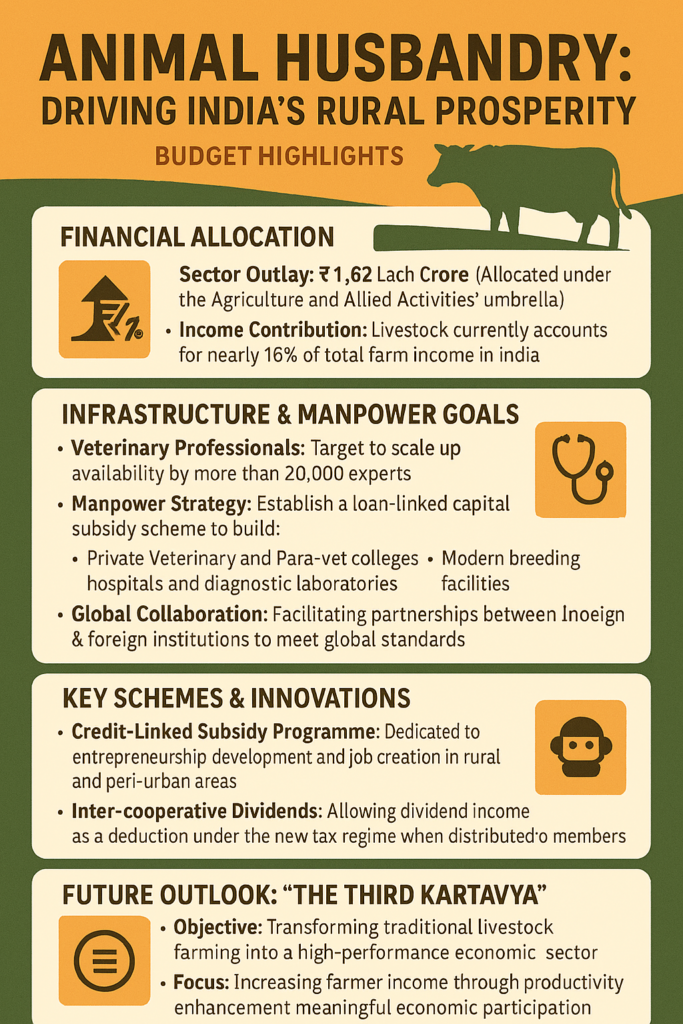
India’s Finance Minister Nirmala Sitharaman on Feb. 1 unveiled a series of targeted interventions for the animal husbandry sector in the Union Budget 2026-2027, focusing on modernizing livestock enterprises and scaling up the country’s veterinary infrastructure. The proposals are part of the government’s “Third Kartavya,” which aims to increase farmer incomes through productivity enhancement and entrepreneurship.
Scaling Veterinary Infrastructure
- A primary highlight of the budget is the government’s plan to scale up the availability of veterinary professionals by more than 20,000 to meet growing industry demands. To achieve this, the minister proposed a loan-linked capital subsidy support scheme for the establishment of veterinary and para-vet colleges, hospitals, diagnostic laboratories, and breeding facilities within the private sector.
- Sources indicate that the government will also facilitate collaboration between Indian and foreign institutions to bring global standards to domestic animal care.
Entrepreneurship & Value Chains
- To provide quality employment opportunities in rural and semi-urban areas, the budget introduces a Credit-Linked Subsidy Program specifically for entrepreneurship development in animal husbandry. This initiative is designed to support the scaling-up and modernization of existing livestock enterprises.
- Furthermore, the government intends to enhance the creation of integrated value chains focused on livestock, dairy, and poultry. To empower small and marginal holders, the budget encourages the formation of Livestock Farmer Producer Organizations (FPOs), mirroring successful models used in other agricultural sub-sectors.
Industry Standing & Economic Context
- According to the sources, the livestock sector currently contributes nearly 16% of total farm income in India, playing a vital role in the livelihoods of poor and marginal households.
- The government views this sector as a critical engine for rural prosperity and meaningful participation in India’s path to becoming a developed nation, or “Viksit Bharat”.
Allocations & Fiscal Framework
- The broader “Agriculture and Allied Activities” sector, which encompasses animal husbandry, has been allocated ₹1,62,671 crore in the 2026-27 budget. This funding is part of a total estimated expenditure of ₹53.5 lakh crore for the fiscal year.
- Budget also highlights specific tax proposals to assist primary cooperative societies engaged in the sector, including allowing deductions for the supply of cattle feed and cotton seed produced by their members.
Technological Integration
- In a move to modernize agricultural practices, the budget introduces “Bharat-VISTAAR,” a multilingual AI tool. This system will integrate agricultural practices with AI to provide customized advisory support, which is expected to benefit animal husbandry practitioners by enabling better decision-making and reducing operational risks.
- By focusing on high-value agriculture and allied sectors, the government aims to transform the potential of rural India into high-performance economic activity. The minister emphasized that these measures ensure every family and region has access to resources and opportunities for meaningful economic participation.
Summary
The future of India’s Animal Husbandry and allied sectors lies in their transformation from traditional livelihoods into modern, high-performance economic engines driven by professionalization, technology, and integrated value chains.